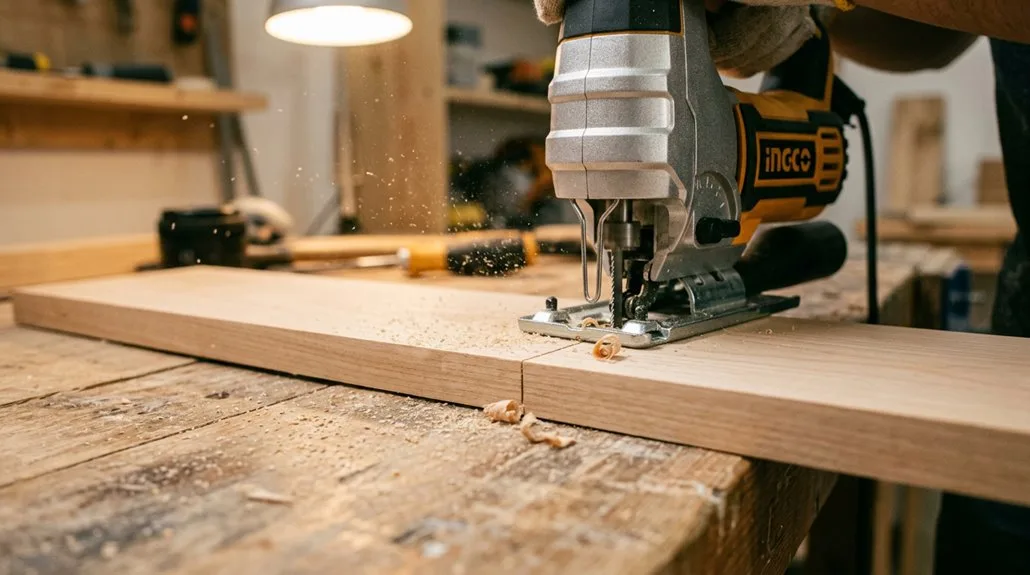
Most woodworkers blame their jigsaw when cuts come out splintered and rough — but the real culprit is almost always the blade. Blade selection alone influences cut quality by up to 60%, yet it’s the step most people skip entirely. Pair that with the wrong speed setting or a poorly clamped workpiece, and even a quality Ingco jigsaw will butcher your lumber. The difference between clean, precise cuts and wasted wood often comes down to three overlooked factors most guides never mention.
Why Blade Choice Determines Clean Cuts on Wood
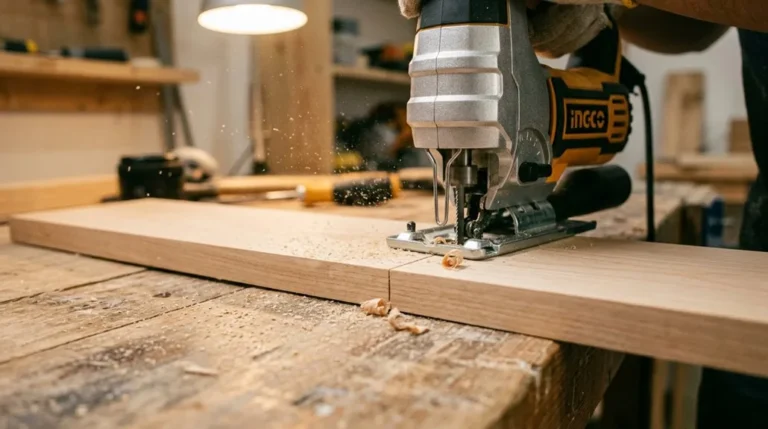
When cutting wood with an Ingco jigsaw, the blade you choose directly controls the quality of your cut. The wrong blade produces rough edges, splintering, and unstable cuts.
Every woodworker in the know grasps this fundamental rule.
Every seasoned woodworker understands this truth: the right blade is the difference between a clean cut and a ruined workpiece.
Tooth count matters considerably. Consider these standard TPI options:
- 6 TPI: Fast, aggressive cuts with a rougher finish
- 10 TPI: Balanced speed and surface quality
- 24 TPI: Slow, controlled cuts in harder materials
Blade thickness also plays a role. Thicker blades reduce deflection and keep your cuts straight. Thinner blades handle curves with greater ease. For tasks requiring more aggressive material removal, pairing your jigsaw work with a 115mm flap disc can help smooth rough edges after cutting.
Finally, tooth direction determines which surface stays clean. Down-cutting blades prevent splintering on laminated wood surfaces. For fine finishing on wood and plastic, reverse-tooth blades deliver smooth edges with a cleaner result on the underside. Choosing correctly delivers a great result every time.
How to Set Up Your Ingco Jigsaw for Wood Cutting
Before you make your first cut, you need to install the right blade for wood cutting — the package includes 3-5 saw blades to get you started.
Next, set your variable speed dial to a higher RPM, between 800-3000rpm, since soft wood cuts faster and cleaner at higher speeds.
Press the jigsaw firmly onto your material before guiding it along your marked line, and adjust the speed down if you’re working with harder, denser wood. For bevel cuts, the bottom plate adjusts up to 45° to help you achieve angled cuts with precision.
For projects requiring precise material quantities, using a digital check weigher can help you measure and manage your workpiece materials accurately before cutting.
Choosing the Right Blade
Getting the blade selection right sets the foundation for clean, accurate cuts with your Ingco jigsaw.
For woodworking, you’ll want a High-Carbon Steel (HCS) blade. HCS delivers durability and holds its edge through extended cutting sessions.
The Ingco 5-piece jigsaw blade set is a great result of practical engineering.
Key specifications to know:
- 8 TPI for balanced cutting speed and smooth finish
- 74mm tooth length for varied wood thicknesses
- 4–5.2mm tooth spacing for efficient debris clearance
These blades handle wood sheets, curved cuts, and crosscuts with consistent results.
Ground teeth eliminate splintering on visible surfaces. You won’t need to sand excessively after cutting.
Installing these blades is straightforward, as compatible Ingco jigsaws support tool-free blade changes. Cool Pack cc stocks a full range of Ingco power and hand tools, making it easy to source your jigsaw and accessories from a single trusted supplier. The blades are also suited for cutting materials beyond wood, including aluminium and mild steel.
Adjusting Speed Settings
With the right blade installed, your Ingco jigsaw is nearly ready to cut. Speed settings directly affect your cut quality. The tool’s variable speed ranges from 800 to 3,000 RPM.
Match your speed to your wood type:
- Hardwoods need lower speeds, around 800 RPM, to prevent burning.
- Softwoods handle higher speeds, near 3,000 RPM, efficiently.
- Thicker pieces require slower speeds for better control.
Monitor your blade during the cut. Increase speed if the cut slows or roughens. Decrease speed if you notice heat, wandering, or material damage. Slow down near the cut’s end to prevent splintering. For added protection during cutting sessions, wearing appropriate heavy-duty safety wear helps guard against debris and accidental contact with the blade.
Always do a test cut first. This confirms your speed setting delivers a great result before committing to your final piece. Before starting, place the blade against the material at a low starting speed to establish proper blade entry into the wood.
Mark, Tape, and Clamp Your Wood the Right Way
A clean cut starts long before you switch on your jigsaw.
Use a pencil and straightedge to mark your cut line clearly. A T-square helps you draw perfectly square lines on wood.
Apply painter’s tape or masking tape directly over your cut line. This holds wood fibres down and reduces splintering, especially on plywood. Re-draw your line on top of the tape if it’s no longer visible.
Next, secure your workpiece with clamps on a stable workbench or sawhorses. Position clamps away from your cut path so they don’t interfere with the jigsaw’s movement.
For long cuts, use two tables and clamp both sides. Make certain enough overhang so the blade clears the table edge cleanly. A 300mm soft household broom kept nearby makes it easy to sweep away sawdust buildup that can obscure your cut line mid-project.
These steps consistently deliver great results. When cutting plywood, position the wood so the good side faces down, since jigsaw blades cut on the upstroke and this keeps the cleaner surface free from splintering.
How Speed and Pressure Actually Affect Your Cut
Once your wood is marked, taped, and clamped, how you operate your jigsaw determines the quality of your cut. Speed and pressure work together, and getting this balance right puts you in the same league as experienced woodworkers.
The Ingco jigsaw’s 800–2800rpm range gives you real control:
- Soft wood cuts best at higher speeds, reducing overall cut time efficiently.
- Plywood requires consistent low-to-medium speed for straighter, cleaner edges.
- Steel up to 8mm demands the lowest speeds to prevent blade damage.
Apply light, steady downward pressure throughout your cut. Excessive pressure binds the blade, causing deviation and tear-out on wood grain edges.
Balanced pressure with matched speed delivers a great result, extending your 5-blade set’s longevity considerably. For metal cutting tasks that go beyond a jigsaw’s range, an angle grinder at 2400W can handle heavier material removal with far greater efficiency.
How to Cut Straight Lines and Bevel Angles With an Ingco Jigsaw
Cutting straight lines with an Ingco jigsaw requires a guide, a marked cut line, and a steady hand.
Clamp a straight piece of wood or a metre stick parallel to your pencil line, measured from the blade to the shoe edge, then keep the shoe pressed firmly against the guide throughout the cut.
For bevel angles, adjust the base plate to your desired angle before positioning the guide, then verify the blade aligns with your marked bevel line before you start cutting.
Straight Line Cutting
Straight cuts are possible with an Ingco jigsaw when you use the right setup. A straightedge guide clamped firmly to your board keeps the saw on track. You’ll get great results by measuring the distance from the blade to the shoe’s edge before positioning your guide.
Follow these steps for accurate straight cuts:
- Draw a pencil line across the full board length, then mark the guide position by measuring the blade-to-shoe distance from that line
- Clamp your straightedge securely on both sides of the board, keeping it warp-free
- Press the shoe firmly against the guide throughout the cut, moving slow and steady
The Ingco 400W jigsaw handles plywood straight cuts without overheating. Jigsaws suit shorter cuts best, while circular saws handle longer production runs. For storing leftover finishes or wood treatments after your project, 500ml square plastic bottles from Cool Pack CC offer a practical and clearly labelled container option.
Bevel Angle Adjustments
Bevel cuts add a slanted edge to your wood, and your Ingco jigsaw handles them with a straightforward angle adjustment system. Loosen the angle adjustment screw by turning the lever anticlockwise. The base tilts to marked positions: 15, 30, and 45 degrees on either side of zero.
Use the included Allen key to loosen the two adjustment screws without fully removing them. Tilt the base to your desired angle using the markings. Set the pendulum to zero for cleaner bevel edges.
Run the blade at full speed before contacting the workpiece. Use slow speed to minimise blade flex during the cut. Clamp your workpiece securely, and let the blade fully stop before lifting from the cut. Once your cut is complete, securing the finished pieces in a bag closing solution helps protect them during transport or storage.
Common Ingco Jigsaw Mistakes That Cause Rough Edges
Even the best Ingco jigsaw won’t deliver clean edges if you’re making common technique errors. Many woodworkers share these same struggles, so you’re not alone.
Here are three mistakes that cause rough edges:
- Wrong blade selection: Using a blade with incorrect TPI removes too much material, creating tear-out on wood surfaces.
- Excessive force: Pushing too hard deflects the blade sideways, producing non-square, bevelled cuts.
- Poor sole plate alignment: A base plate not sitting at 90 degrees to the blade creates unintended bevels.
Fix these three issues and you’ll see a great result immediately. Coolpack cc stocks quality Ingco jigsaw blades in Paulpietersburg, South Africa, giving you the right tools to cut cleanly every time. For personalised guidance on blade selection and cutting technique, IPSA-certified specialists at Cool Pack CC on R33, Paulpietersburg, are available to help you get the best results from your Ingco jigsaw.
Which Ingco Jigsaw Model Suits Your Wood Cutting Projects?
Choosing the right Ingco jigsaw makes a real difference in how cleanly and efficiently you cut wood. Ingco offers five models, each suited for different project types and skill levels.
For cordless flexibility, the CJSLI8501 cuts wood up to 80mm at 2400rpm. The CJSLI1008 adds variable speed and tool-free blade change, making it great for on-site work.
For corded power, the JS80068 delivers 800W with wood cutting capacity reaching 135mm. It also features a 4-step pendulum function for cleaner cuts. The JS80028 suits workshops and construction projects. The JS57028 runs at 570W and delivers a great result for DIY enthusiasts and professionals on a budget.
You’ll find all five models available at Coolpack cc in Paulpietersburg, South Africa. Coolpack cc also stocks a range of packaging and industrial products, including woven polypropylene bags, netlon, and twine suited for agricultural and construction use.