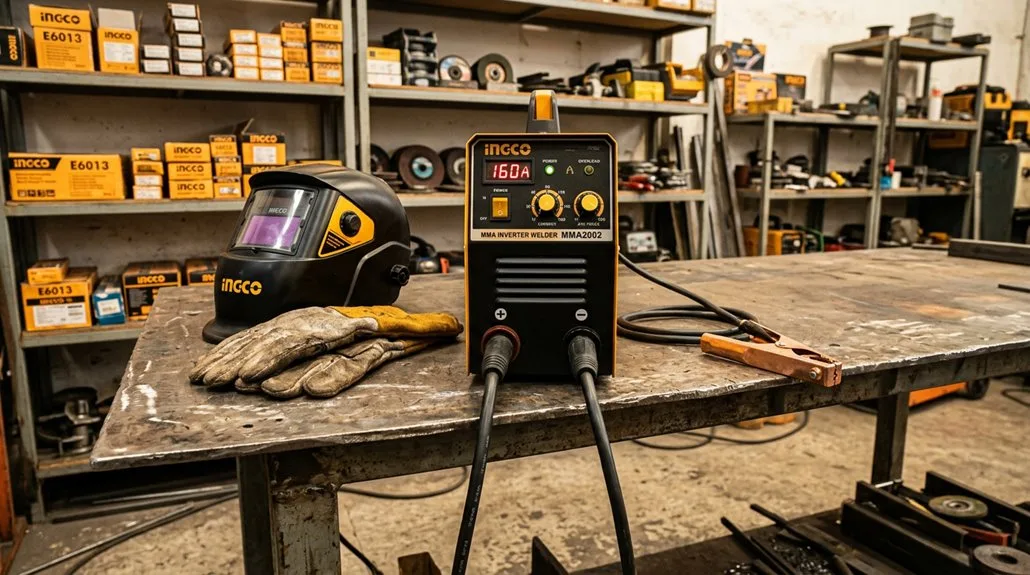
Most welders assume a quick glance at the connections is enough before striking an arc. It isn’t. One overlooked step when setting up your Ingco welding machine can silently compromise your safety, damage your equipment, or turn a simple project into a costly disaster. The setup process isn’t just a formality—it’s the difference between a clean weld and a dangerous situation. Before you touch that electrode, there’s a precise sequence you need to follow.
Put On the Right Safety Gear Before Anything Else
Before you strike your first arc, put on the correct personal protective equipment (PPE).
Every welder who takes safety seriously wears the right gear.
You’re part of a community that values protection and professionalism.
Start with a welding helmet.
Auto-darkening helmets adjust shade automatically; fixed-shade helmets use shade 10.
Wear safety glasses underneath against slag and debris.
Your hands need heavy-duty leather gloves.
They cover your hand, wrist, and lower forearm.
Thick leather suits GMAW and SMAW welding best.
Protect your body and feet too:
- Jacket/apron: Flame-resistant material, reinforced elbows and shoulders
- Boots: Steel-toed, protecting against hot debris
- Respirator: NIOSH-certified with P100 filters for fume protection
OSHA and ANSI Z49.1 require all this PPE.
Don’t skip any of it.
For additional skin and clothing protection, a PVC or disposable apron provides a reliable barrier against sparks and spatter during welding tasks.
Your welding helmet shields your eyes and face from UV and infrared rays produced by the welding arc.
Check Your Ingco Welder Before You Plug Anything In
Once your PPE is on, inspect your Ingco welder thoroughly before connecting it to any power source. Check the power cord along its entire length for cuts, fraying, or exposed wires. Verify the plug prongs are straight and undamaged, and confirm the ground pin is intact.
Next, examine your welding cables and leads for wear, cuts, or defects. Tighten all connections securely to prevent dangerous leaks. Check that the electrode holder is in good condition, with no unintended metal contact.
Finally, confirm the earthing clamp and cable show no rust or damage. Inspect all switches and operating controls for defects. If you are welding in a damp location, GFCI protection is required to guard against electrical shock hazards. Every welder in this community knows a thorough pre-check protects both you and your equipment before work begins. For extended welding sessions that demand reliable power delivery, pairing your setup with a 5AH battery ensures consistent performance without interruption.
Connect Your Ingco Welding Machine the Right Way
Once your welder is inspected and positioned correctly, you can make the physical connections.
Connect the ground clamp cable to the negative (-) output terminal, and attach the electrode holder cable to the positive (+) output terminal, twisting each plug firmly to lock it in place.
After securing both clamp slot connections, turn the power switch ON and use the adjustment knob to set your amperage within the 15–130A range, matching the setting to your electrode size and material thickness. For personalised guidance on settings and compatible consumables, you can reach out to IPSA-certified specialists who are available to assist with expert advice on industrial gear and welding equipment. Ensure your browser has JavaScript and cookies enabled, as some digital welding reference tools and manufacturer resources require these features to load properly during setup.
Clamp Slot Connections
Connecting your Ingco welding machine’s cables to the correct terminals is a critical step that directly affects arc stability and weld quality. You’ll insert the ground clamp cable into the negative (-) terminal and the electrode holder cable into the positive (+) terminal. Both connectors lock securely with a firm twist.
Follow these terminal connection requirements:
- Ground clamp cable: Insert fully into the negative (-) terminal, then twist to lock
- Electrode holder cable: Insert fully into the positive (+) terminal, then twist to lock
- Surface preparation: Attach the ground clamp to clean, bare metal only
- Connection security: Tighten all terminals firmly to prevent arc instability
Loose connections cause weak welds and overheating. Verify both connections before starting your arc. For additional Ingco tool support, a dedicated supplier can provide expert guidance to ensure your machine is correctly configured for optimal performance. If you are unable to access setup references during this process, JavaScript and cookies must be enabled in your browser to continue loading the manufacturer’s online documentation.
Selecting Correct Amperage
Dialling in the correct amperage on your Ingco welding machine directly determines weld quality and material integrity. Use the basic rule: 1 amp per 0.001 inches of steel thickness. Stainless steel needs 10–15% less current; aluminium needs 25% more.
| Material | Thickness | Amperage Range |
|---|---|---|
| Mild Steel | 1.6 mm | 50–70A |
| Stainless Steel | 1.6 mm | 40–60A |
| Aluminium | 3.2 mm | 140–160A |
| General Steel | 1.5–2 mm | 60–90A |
| MIG Wire (.030″) | 1/8 inch steel | 130–140A |
Start at the recommended setting, then adjust gradually. A narrow, convex bead means low amps. Wide beads with spatter signal high amps. Your Ingco MMA1805 delivers 180A at 40% duty cycle—great results come from staying within these limits. For industrial applications requiring precise weight verification of materials, a check weigher scale can help ensure your steel stock meets specified thickness tolerances before welding begins. Bevelling and joint preparation can reduce the required current on thicker materials, allowing cleaner single-pass welds without pushing your machine beyond its rated capacity.
Set the Right Amperage for Your Ingco Welder
Getting the amperage right makes the difference between a strong, clean weld and a messy, weak one. Start with your machine’s chart recommendations for your metal type and electrode size.
Here’s a quick reference:
- 1.6mm electrode: 25–40A
- 2.5mm electrode: 60–90A
- 3.2mm electrode: 80–130A
- 4.0mm electrode: 130–170A
Watch your puddle closely. A correct puddle width equals two electrode diameters. If it looks wide and watery with spatter, you’re running too hot.
If your weld sits tall and narrow, increase your amperage.
Adjust in 3–5A increments until you get a great result. Note that your dial may read higher than your actual output, so always test on scrap metal first.
Prepare Your Ingco Welding Space Before Striking an Arc
Before you strike your first arc, you need to prepare your welding space properly. A clean, well-lit work area prevents accidents and keeps you focused.
Prepare your welding space before striking your first arc. A clean, well-lit area prevents accidents and keeps you focused.
Avoid areas with flammable liquids, gases, or dust. These create explosive atmospheres that put everyone at risk. Keep children and bystanders away from your operating area.
Use a welding booth to contain sparks and fumes effectively. Adequate ventilation is non-negotiable. Without it, harmful fumes build up quickly and compromise your safety.
Follow these key preparation steps:
- Clear clutter from your work area
- make certain sufficient lighting
- Confirm proper ventilation
- Set up a welding booth
- Remove all bystanders from the space
Secure your workpiece and materials using industrial wire ties to keep them stable and prevent unexpected movement during welding.
A well-prepared workspace gives you great results and builds good welding habits from the start.
Test Your Settings on Scrap Before Welding the Real Piece
You should always test your Ingco welding machine settings on scrap metal before committing to the real piece. Choose scrap that matches your base metal’s type and thickness. Clean it thoroughly to remove rust, paint, oil, or galvanizing before striking an arc.
Set your Ingco machine to your intended amperage, voltage, and polarity. Weld short test beads, maintaining consistent travel speed and angle. Record every setting used for each sample.
Inspect each test weld immediately. Check for undercut, porosity, incomplete fusion, and proper reinforcement. Use liquid penetrant for surface crack detection after cleaning and drying.
Repeat tests with adjusted settings until results meet quality standards. Tag successful scrap samples as reference. Experienced welders follow this process every time — and you should too. For additional protection during the testing process, ensure you’re equipped with heavy-duty safety wear suited for industrial and agricultural welding environments.
How to Read Your Test Weld and Adjust Ingco Settings
Once you’ve run a test bead on scrap metal, you need to examine it closely for common weld defects like porosity, undercutting, and uneven bead width.
If the bead looks too flat or shows spatter, your amperage is likely too high; if it’s raised and uneven, it’s probably too low. Adjust your Ingco machine’s amperage in small increments, typically 5–10 amps at a time, and run another test bead until you achieve a smooth, consistent weld profile.
Identifying Common Weld Defects
Running a test weld is a smart first step when setting up your Ingco welding machine. It reveals defects before you commit to a real project. Knowing what to look for puts you ahead.
Check your test weld for these common defects:
- Cracks – Straight breaks on the weld surface that reduce strength
- Undercut – Grooves forming at the weld edge, thinning the metal
- Porosity – Tiny holes or gas bubbles indicating contamination or poor shielding
- Lack of penetration – Weld failing to reach joint depth, creating weak bonds
Use a magnifier for visual inspection. Dye penetrant testing highlights surface defects as red marks.
Catching these early saves materials and time. Every skilled welder learns this process, and you’re already on the right track.
Adjusting Amperage for Results
Your test weld tells you exactly what needs to change. Read the puddle width first. A width equal to two electrode diameters confirms correct amperage on your Ingco MMA2506.
Adjust based on what you see:
- Wide puddle with spatter → reduce amperage in 3–5A increments
- Narrow, tall bead → increase amperage gradually
- Burn-through or warping → decrease immediately
Position matters too. Vertical welding requires 10% less than your flat baseline. A 125A flat setting becomes 113A vertical using the 0.90 multiplier. Overhead position uses a 5% reduction instead.
Start within the manufacturer’s recommended range for your electrode size. A 3.2mm electrode suits 80–130A for 6mm steel. Fine-tune after each test pass. Consistent adjustments deliver a great result every time.
Testing on Scrap Material
Always test on scrap metal before committing to your actual project. Select clean pieces matching your project’s material thickness, cut 6–12 inches long. Secure them in a vice to prevent movement.
Follow this testing sequence:
- Set your Ingco machine’s initial voltage and wire speed per the manual.
- Strike the arc and weld a straight bead 4–6 inches long.
- Inspect bead width (3–8 mm indicates a stable arc) and check for porosity or spatter.
- Adjust voltage incrementally, document ideal settings, and re-test until defects disappear.
You’re part of a community that values doing things right. Allow each weld to cool before evaluating results.
Record your final settings for consistent, great results on your actual project material.