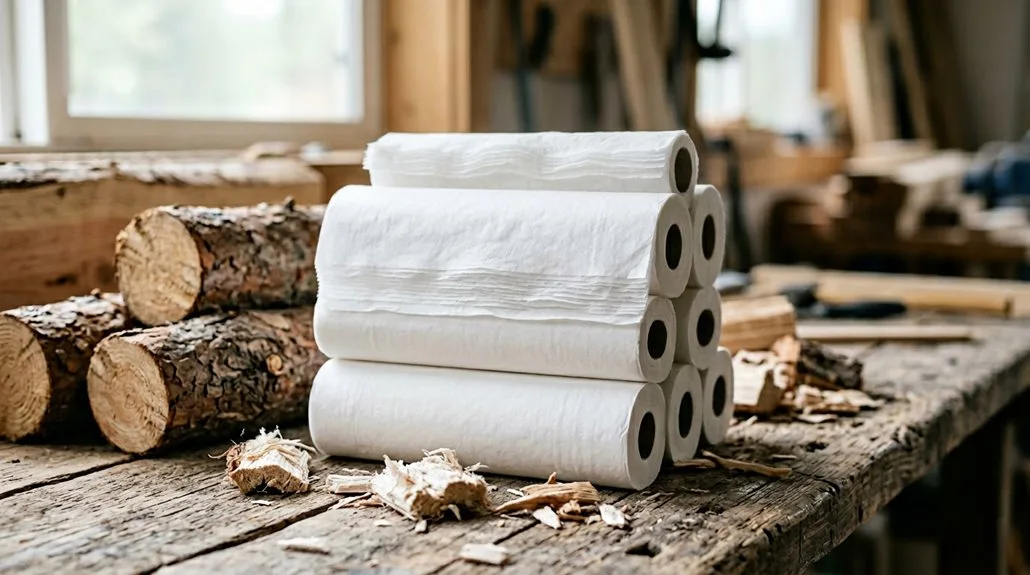
Most people never think twice about what’s actually in their tissue paper—but maybe they should. Every roll you reach for has a story written in wood fibres, shaped by chemical processing, precise bleaching, and fibre enhancement that recycled alternatives simply can’t match. Virgin wood pulp tissue paper isn’t just a manufacturing choice; it’s the reason some tissues feel softer, perform stronger, and stay cleaner. The science behind it will change how you see something you use every single day.
What Is Virgin Wood Pulp Tissue Paper?
Virgin wood pulp tissue paper comes from unprocessed wood fibres, derived directly from trees with no recycled content. You’re working with the highest-quality raw material available for tissue production. The process involves debarking, chipping, and chemical pulping.
Wood pulp contains these key components:
- Cellulose: 40–45%
- Hemicellulose: 23–35%
- Lignin: 20–30%
- Extractives: 2–5%
The finished tissue contains 80% or more fibres, producing uniform, delicate paper with fewer additives. This guarantees your tissue remains free from impurities, contaminants, and fibre degradation. Businesses operating in commercial and industrial environments rely on premium-grade materials like virgin wood pulp tissue to meet strict hygiene and sanitation standards.
You get a product that delivers consistent performance every time — a great result for both commercial and domestic use. Softwoods such as spruce, pine, and fir are commonly preferred for tissue production because longer cellulose fibres yield a stronger, higher-quality end product.
How Virgin Pulp Goes From Tree to Tissue Paper
Grasping what tissue paper is made of tells only part of the story. Understanding how it’s made gives you the full scene. The process moves through several clear stages, each building on the last.
Knowing what tissue paper is made of is only half the picture. How it’s made tells the rest.
It starts with raw trees. Softwood and hardwood are combined at a 30/70 ratio, chipped, and pulped using either the chemical Kraft process or mechanical grinding. The pulp is then washed, bleached, and refined.
Next, it’s diluted into a slurry of 99% water and 1% fibre, then spread onto wire mesh screens. Water drains away, forming a wet web that’s pressed and dried down to roughly 5% moisture. For large-scale operations requiring consistent material inputs, bulk packaging orders can be arranged through specialist suppliers to keep production running without interruption.
Finally, large jumbo reels are cut, perforated, and inspected. Defective rolls are removed. You get a clean, consistent product. A creping unit then scrapes the dried web with a metal blade to create wrinkles, giving the tissue its characteristic softness and bulk.
Why Virgin Pulp Tissue Paper Feels Softer and Cleaner
The softness of tissue paper comes down to one thing: fibre quality. Virgin wood pulp contains long, unbroken fibres that create a uniform mat.
This structure produces a softer, lint-free texture you’ll notice immediately.
The fibre blend matters too. A 30% hardwood to 70% softwood ratio balances smoothness and durability.
Hardwood fibres from birch and eucalyptus add surface smoothness, while softwood fibres from pine and spruce provide strength.
Cleanliness comes from purity. Virgin pulp contains no recycled inks, dyes, or adhesives.
After drying, the final product reaches 97% pure fibre.
No de-inking process is needed, so natural fibre integrity stays intact.
You’re getting a great result from a product that’s built from scratch, with zero contamination from post-consumer waste. For food-related applications, pairing virgin pulp tissue with quality grease proof packaging can further protect products from contamination and moisture transfer. Softness testing using instruments like the Handle-O-Meter confirms that virgin pulp tissue consistently meets high consumer satisfaction benchmarks.
Virgin Pulp vs. Recycled Tissue Paper: What’s the Difference?
Both tissue papers start from very different raw materials, and that difference shapes everything about the final product. Virgin pulp comes from fresh wood chips, while recycled pulp comes from collected waste paper.
The raw material tells the whole story — fresh wood chips versus collected waste paper changes everything.
Here’s what sets them apart:
- Virgin pulp uses a 30% softwood and 70% hardwood blend
- Recycled pulp processes post-consumer paper through blending and contaminant removal
- Virgin slurry contains 99% water and 1% fibre during forming
- Recycled fibres may carry residual inks from reprocessing
- Virgin pulp delivers higher purity, softness, and consistent whiteness
You’re choosing between environmental reuse and premium quality. Recycled tissue reduces waste, but virgin tissue offers untouched fibres with no prior contaminants. For businesses sourcing materials at scale, packaging solutions suppliers can often advise on complementary storage and dispensing options suited to tissue products.
Grasping this difference helps you make informed decisions about the products you bring into your space. Recycling recovers roughly 670–700 tons of fibre from every 1,000 tons of waste paper processed, making it a resource-efficient route but one that still falls short of the purity achieved through virgin pulp production.
The Virgin Pulp Standard Behind Every Sheet We Make
Knowing the difference between virgin and recycled pulp sets the stage for grasping what actually goes into producing a premium sheet.
Every sheet starts with virgin wood pulp sourced from sustainable forests. You’re getting fibre that’s never been used or recycled before.
The raw material blend follows a precise ratio:
- 70% hardwood fibre
- 30% softwood fibre
This combination delivers both softness and strength.
Hardwood trees provide fine fibres for smoothness, while softwood trees contribute longer fibres for durability.
The pulping process then cooks these chips under high temperature and pressure.
This dissolves lignin and separates clean cellulose fibres.
You end up with a pure pulp paste ready for paper making.
Every sheet meets strict standards for softness, absorbency, and strength. Products like 2-ply Kitten Soft demonstrate how these manufacturing standards translate directly into a finished consumer toilet paper roll.
That’s the virgin pulp standard you can count on. Removing lignin is a critical step because its presence causes paper to yellow over time.