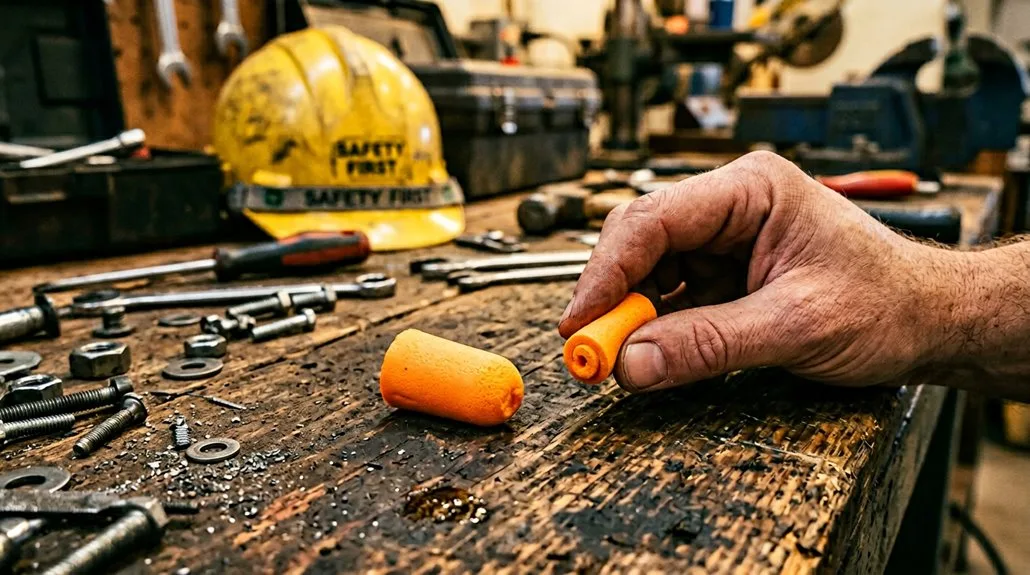
Most workers jam foam ear plugs straight into their ears and call it done — and most workers are dangerously wrong. This seemingly simple piece of safety equipment carries a fitting process so precise that skipping it can strip away up to 90% of its protective power. Meanwhile, harmful noise levels quietly do their damage. If you’ve never been formally shown the correct method, there’s a strong chance you’ve been wearing them wrong this entire time.
Why Most Workers Fit Foam Ear Plugs Wrong
Foam ear plugs offer strong hearing protection, but only when fitted correctly. Studies show more than half of workers achieve under 50% of the labelled protection level, even after training. You’re not alone if your plugs aren’t working as expected.
The most common mistakes include:
- Shallow insertion — leaving gaps that reduce noise blocking markedly
- Skipping canal straightening — your canal curves backward and upward, requiring you to pull the ear up and outward
- Poor rolling technique — wrinkles and creases prevent a tight seal
- Releasing too soon — foam needs 20–30 seconds to expand fully
Recognising these errors is a great result of proper awareness. Correcting them delivers the protection you deserve. For workers in high-risk environments, pairing ear plugs with other PPE safety wear such as dust masks and protective eyewear can provide a more comprehensive approach to workplace safety. Another overlooked factor is that ear canals vary significantly in size and shape from person to person, meaning a plug that fits one worker well may provide little protection to another.
Match the Foam Ear Plug Size Before You Start
Most foam ear plugs come in a standard diameter of 0.54 inches (13.7 mm), but that single size doesn’t fit every worker. Your ear canal is unique, and your left and right ears may even differ from each other.
Sizing tools like the Eargage use plastic spheres ranging from 7 mm (extra small) to 11 mm (extra large) to estimate your canal size. Start with a sphere that matches your canal opening. Adjust up if it’s too loose, or down if it won’t insert fully. For workers in agricultural and industrial environments, access to expert advice on the right protective gear can make a significant difference in long-term hearing health.
Small foam plugs measure 0.47 inches (11.9 mm) in diameter. Larger plugs carry higher NRR ratings, but they’ll fit poorly in smaller canals. Getting your size right before insertion gives you a great result every time. Hearing protection becomes especially critical in environments where noise levels reach 85 dBA or higher, the threshold at which prolonged exposure begins to cause permanent damage.
Roll the Foam Ear Plug Correctly Before Inserting
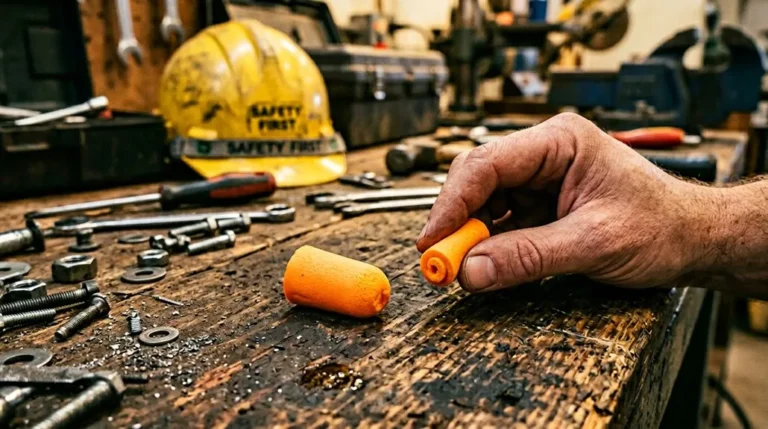
To insert a foam earplug correctly, you need to roll it into a tight, thin cylinder first.
Use your fingers and thumbs to compress the plug lengthwise, rolling it into a smooth, crease-free shape no thicker than a small, thin snake.
If creases form during rolling, apply progressive pressure gradually and re-roll the plug until you achieve a clean, compressed cylinder small enough to fit your ear canal.
This step is especially important in loud work environments, as loud noises cause irreversible hearing loss that you simply cannot get back.
Rolling Technique Basics
Rolling your foam earplugs correctly is the first step toward effective hearing protection. You’ll compress the plug into a thin, uniform cylinder before insertion. This secures a proper seal inside your ear canal.
Follow these rolling technique basics:
- Compress lengthwise by rolling the plug between your thumb and fingers until it forms a thin “snake” shape.
- Use clean hands to prevent dirt and germs from entering your ears during handling.
- Roll uniformly without mashing vertically, which prevents proper expansion inside the canal.
- Inspect each plug for tears, cracks, or hardening before rolling.
High-quality foam maintains elasticity throughout this process. You’ll know you’ve achieved a great result when the plug rolls smoothly without resistance. Proper compression guarantees effective noise reduction after insertion. In noisy industrial environments, pairing ear plugs with digital industrial scales and other precision equipment helps maintain overall workplace safety standards. Before rolling, pull your ear upward and outward to help straighten the ear canal for a more accurate and comfortable fit.
Preventing Creases and Wrinkles
Creases and wrinkles in foam earplugs create tiny tunnels that let sound bypass the seal entirely. This compromises your noise reduction rating (NRR), leaving your hearing unprotected. You’re part of a team that takes safety seriously, so getting this right matters.
Roll the plug between your thumb and forefinger using a gentle, continuous motion. Apply light pressure first, then gradually increase it. You’re aiming for a thin, smooth cylinder, like a small “snake,” with no creases. For best results, use freshly gloved or washed hands before rolling to avoid transferring oils or contaminants to the foam.
Avoid these common mistakes:
- Squeezing too hard too quickly
- Rolling into cone or ball shapes
- Applying uneven pressure
A wrinkle-free cylinder expands uniformly inside your ear canal, creating a complete seal. That’s a great result for your hearing protection efforts. For broader workplace safety needs, suppliers like Cool Pack cc also stock packaging and industrial products alongside safety wear to support a well-equipped work environment.
Pull Your Ear Back So the Plug Reaches the Canal
With your rolled plug ready, reach across with your opposite hand to grasp your outer ear between your thumb and forefinger. Pull your pinna outward and upward to straighten your ear canal. This widens the opening for a smoother insertion.
This technique delivers great results when done correctly:
- Pull your left ear with your right hand, and vice versa
- Reach behind or over your head to grasp the pinna firmly
- Maintain the pull until the plug sits fully inside the canal
- Release your ear only after complete insertion
Releasing too soon displaces the expanding foam. A firm, sustained pull aligns your canal perfectly.
You’ll achieve better depth, improved low-frequency noise blocking, and a secure, comfortable fit every time.
Insert the Foam Ear Plug Deep Enough to Work
Slide the compressed plug gently into your ear canal until the bottom edge sits flush with the canal opening. You’ll achieve a great result when at least half the plug’s length sits inside the canal. A typical adult ear canal measures approximately 32 mm long, so depth matters.
Deeper insertion delivers increased protection, especially against low-frequency noise. Even an eighth of an inch deeper can double your protection level. The foam expands fully, distributing force evenly along the canal walls.
Don’t worry about going too deep. The plug won’t reach your eardrum. Check for wrinkles or creases on the foam. A smooth, snug fit confirms you’ve inserted it correctly, and you’ll notice noticeably better noise reduction immediately.
Hold the Foam Ear Plug Until It Fully Expands
Once the plug is seated correctly, hold it in place for 30 to 60 seconds while it expands. Count to 20 or 30 out loud to track the time accurately. This step guarantees the foam fills every bend and curve of your ear canal.
Keep these key points in mind:
- Maintain finger contact for the full 30 seconds as the foam expands
- Pull your ear upward and outward to keep the canal straightened during expansion
- Avoid pushing or twisting once expansion begins, as this unsettles the seal
- Release and re-press for 5 seconds afterward to confirm a great result
A properly expanded plug creates a noticeable sensation of fullness, confirming effective noise blockage.
Signs Your Foam Ear Plugs Are Seated Correctly
Once the foam ear plug expands fully, you’ll notice your own voice sounds muffled when you speak out loud — this confirms a proper seal inside the ear canal.
You should see minimal plug visibility, with roughly ¾ of the plug seated deep inside the canal and no foam bulging outside the ear.
Cup both hands over your ears as a final check; a noticeably greater muffling effect signals the plugs are correctly fitted and providing their rated noise reduction level.
Muffled Sound Confirms Fit
After inserting your foam ear plugs, you’ll want to confirm they’re seated correctly before relying on them for protection.
A simple muffled sound test tells you immediately whether your plugs are working. Rub your thumb and forefinger together near your ear after insertion.
A correctly fitted plug produces these confirmations:
- No audible rubbing sound means the plug has sealed your ear canal completely.
- Muffled ambient noise confirms deep, even insertion with effective attenuation.
- Reduced low-frequency sounds signal the plug has expanded fully against your canal walls.
- Silence during the finger-rub test verifies noise reduction is active and reliable.
An audible rubbing noise indicates incomplete blockage. Reinsert the plug immediately.
Everyone deserves dependable hearing protection, and getting this right makes certain you’re genuinely protected throughout your workday. Suppliers serving agricultural and industrial clients across regions like KwaZulu-Natal and Mpumalanga stock the heavy-duty PPE and safety wear needed to meet these protection standards on the job.
Minimal Plug Visibility
Correct placement shows itself in a simple, reliable way: the plug nearly disappears inside your ear.
When you’ve inserted the plug properly, it sits fully within the canal entrance. You won’t see much of it from the front.
Check your fit using one of these methods:
- Visual check: Ask a fitter to look at your ear from the front.
- Fingertip check: Feel around the outer ear yourself.
If the plug projects outward noticeably, it’s sitting too shallow.
Proper insertion allows the foam to expand inside the canal, pulling the plug inward. This reduces external exposure markedly.
Workers who get this right achieve a great result — full protection, with the plug barely visible.
Workplaces that also supply certified PPE and safety wear alongside hearing protection create a more complete and consistent approach to worker safety on site.
Hands Cup Test
The hands cup test quickly tells you whether your foam ear plugs are seated correctly. Cup both palms firmly over your ears immediately after insertion. Release your hands and note any change in perceived sound.
A great result means minimal difference in noise level before and after releasing your hands. Watch for these four indicators:
- No significant volume increase after releasing cupped hands
- Sound remains consistent across both ears
- Cupped hands produce minimal effect on perceived sound
- Noise level stays steady, confirming a proper seal deep in your ear canal
If one ear sounds louder than the other, refit that plug. Hold the compressed plug in place for 30–60 seconds before testing, allowing full expansion against your canal walls.